
Counter-Beam Lighting and the qc Coefficient
Enhancing Perceived Contrast Through Directional Lighting Design While luminance level and veiling luminance are critical parameters, the direction of light also plays a decisive role in tunnel entrance visibility. This is where counter-beam lighting and the associated qc (contrast revealing coefficient) become highly relevant. Counter-beam lighting is a directional lighting strategy in which luminaires are […]
Lseq ≠ L20
Why the L20 Method Is No Longer Adequate for Modern Tunnel Lighting The statement “Lseq ≠ L20” reflects a fundamental shift in tunnel lighting philosophy. Although both parameters are used to assess tunnel entrance conditions, they are based on entirely different conceptual frameworks and serve fundamentally different purposes. L20 is a geometric and environmental metric. […]
Why the Classical L20 Method is Insufficient
Limitations of a Historically Important but Outdated Design Approach The L20 method represents one of the earliest systematic approaches developed for tunnel entrance lighting design. For decades, it was widely adopted because it offered a relatively simple and practical way to estimate the required lighting level at tunnel entrances. The fundamental premise of the method […]
Definition of Lseq According to CIE – Why Lseq Is Essential
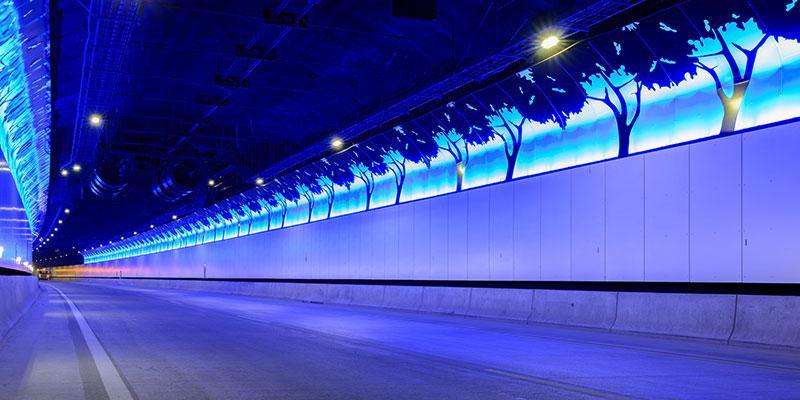
Quantifying Veiling Luminance to Represent Real Visual Conditions To evaluate perceived contrast objectively, tunnel lighting design requires a parameter that represents the contrastreducing effects present in the driver’s visual field. This requirement led to the introduction of Lseq (Equivalent Veiling Luminance), a key concept in modern tunnel lighting methodology. Lseq is defined as the luminance […]
Perceived Contrast and Its Role in Tunnel Lighting
Why Visibility Depends on What the Driver Perceives, Not on Absolute Luminance One of the most fundamental misunderstandings in tunnel lighting design is the assumption that safety can be ensured simply by increasing lighting levels. While luminance is an essential parameter, it does not by itself guarantee visibility. What ultimately determines whether a driver can […]
The Black Hole Effect and Its Relationship with Lseq
Perceptual Visibility Loss at Tunnel Entrances and the Role of Veiling Luminance The “black hole effect” is one of the most wellknown and hazardous visual phenomena associated with tunnel entrances. It describes a situation in which the tunnel opening appears to the driver as a dark, featureless void, preventing the perception of the roadway, obstacles, […]
Visual Adaptation Times at Tunnel Entrances
Human Visual Limitations and Their Impact on Tunnel Lighting Design Visual adaptation is one of the most critical factors governing safety at tunnel entrances. It refers to the ability of the human visual system to adjust to changes in environmental luminance. When a driver transitions from a bright outdoor environment into a darker tunnel interior, […]
Lighting as the Key to Safe Transportation in Tunnels
The Direct Relationship Between Visual Perception, Driver Behavior, and Accident Risk Safe transportation in tunnels is often associated with geometric design, pavement quality, or traffic control systems. However, international standards and long-term operational experience demonstrate that lighting quality is one of the most decisive factors influencing tunnel safety. Tunnel lighting directly affects how drivers perceive […]
The Importance of Tunnel Lighting
A Fundamental Safety Requirement According to CIE Tunnel and Underpass Lighting Guides Tunnel lighting represents one of the most critical and technically demanding applications within road lighting engineering. The challenge does not arise solely from the enclosed nature of tunnels, but primarily from the fact that drivers are required to transition abruptly from a high-luminance […]